
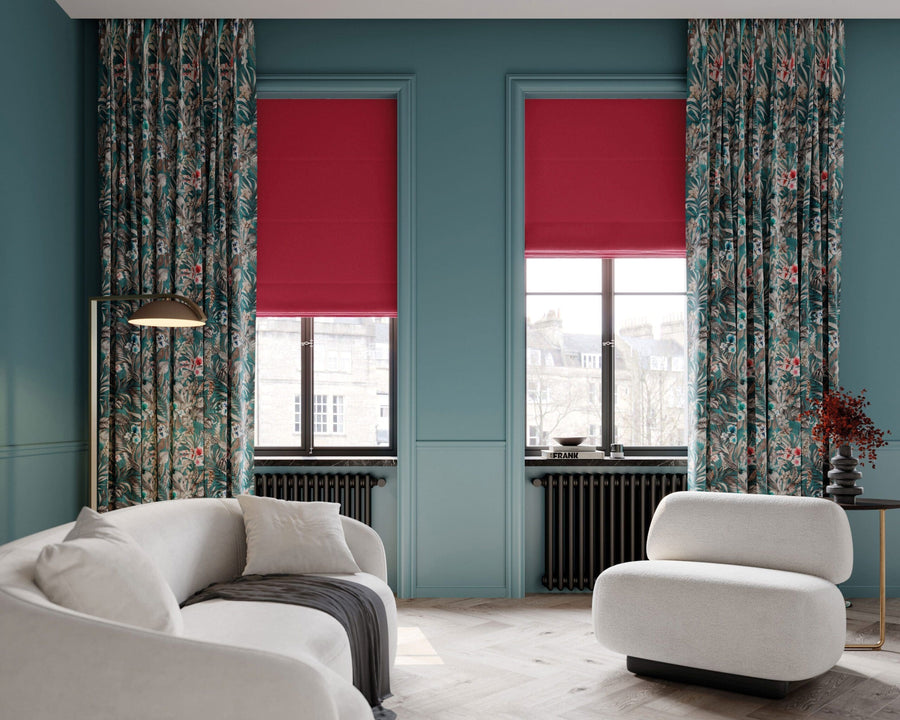
This choice usually comes down to one question: do you want the fabric to frame the window, or to sit neatly within it? Curtains frame. Roman blinds sit. Everything else follows from that, and most of it is practical rather than a matter of taste.
How each one works
A curtain hangs from a pole or track and opens sideways. You draw it across, and it stacks to the sides when open. A Roman blind is a flat panel of fabric that lifts upward and folds into neat horizontal pleats as it rises. When it is lowered, it is flat against the window. See our pages on curtains and Roman blinds for the range overview.
Head to head
Light control
Curtains can cover glass and the wall around it, so they can block light and draughts at the edges when well sized. Roman blinds are neat but usually fit within or just beyond the window frame, so a little light can show at the sides. Either can be lined, and the lining, not the style, mostly decides how dark the room gets. Ask about options if you want help with light control in a bedroom.
Space and stacking
Curtains need room at the sides to stack, and a wall or furniture next to the window can get in the way. Roman blinds need none of that. When raised, though, a Roman blind folds into a stack at the top, which covers a few inches of glass. If you want every inch of daylight, that matters on a small window.
Look and feel
Curtains add height, softness and a bit of drama, and can make a ceiling feel higher when hung above the frame. Roman blinds look tailored and calm, and suit modern rooms and smaller windows. Patterned fabric looks different in each, because a blind shows a flat panel while a curtain shows folds.
Cleaning and care
Curtains are the larger item and can be heavy, but some can be washed or dry cleaned depending on fabric and lining. Roman blinds are lighter to dust and often spot cleaned, but the lining and internal rods usually mean they cannot just be thrown in the wash. Always check care instructions for the specific fabric.
Safety with children and pets
Curtains have no cord to worry about, though a tie-back or heavy pole needs to be secure. Roman blinds normally operate with a cord or chain, and the lifting cords at the back are a recognised risk for young children. Keep controls tied up and out of reach, and ask us about cordless or motorised options. See child-safe blind choices. BS EN 13120 is the UK standard that covers the safety of internal blinds.
Which rooms suit which
- Bedrooms: curtains, or a lined Roman blind on a small window. Layering both is common.
- Living rooms: curtains on large or bay windows, Roman blinds on side windows.
- Kitchens: a Roman blind keeps the fabric away from worktops and the cooker, though it is not ideal directly over a sink. Wipeable blinds like rollers may be better.
- Bathrooms: fabric is not the first choice because of steam. See our bathroom guide.
- Dining rooms: either, depending on how formal you want it.
Windows that push you one way
- Window with a radiator underneath: long curtains can drape over it and block the heat into the room, so a blind or sill-length curtains are often easier. Ask us what suits your window.
- Patio doors: curtains slide clear of the door, or consider other blinds for patio doors.
- Deep recess: Roman blinds sit well inside it.
- Shallow recess or none: a pole above the window and curtains hide the shortage of depth.
Using both together
A Roman blind close to the glass with curtains outside it gives you layers: a light fabric by day, and warmth, privacy and darkness in the evening. It costs more than either alone, but it also gives the most control.
A short checklist before you decide
- Is there space at the sides for curtains to stack?
- Do you want the whole window clear when open?
- How dark does the room need to be at night?
- Are there young children or pets in the room?
- How much care are you happy to do?
If you're torn, book a free measure. We can talk through the practical points at the window and give you a quotation before you commit.
