
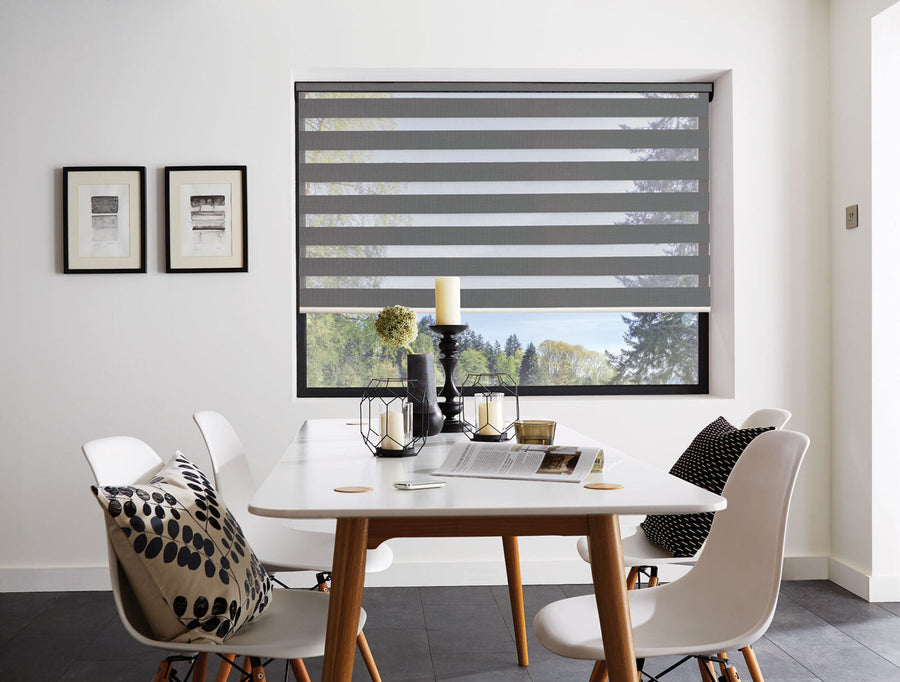
Motorised blinds are ordinary blinds with a small motor built in or fitted alongside. Instead of pulling a cord or turning a chain, you press a button. That sounds simple, and day to day it is. The decisions that matter come before the blind goes up, so this guide sticks to those.
Where a motor earns its place
Motors are worth the extra thought when manual operation is awkward or unsafe:
- Tall or wide windows where a long cord or a heavy blind is a chore to move.
- Windows behind furniture, such as a sink, a desk or a sofa back, that you have to lean across.
- Roof windows and high glazing that are out of comfortable reach. Our roof blinds page explains the types.
- Homes with small children, because a motorised blind has no looping cord to dangle.
- Anyone with limited grip or reach, where a handset is easier than a chain.
If you have one small window in a spare room, a manual blind may suit you perfectly well, and a motor is a nice extra rather than a need.
How the power gets there
This is the first real decision, and it shapes everything else. Depending on the range, a motorised blind may be powered in one of these ways:
- Rechargeable battery. No wiring, so it suits rooms that are already decorated. You'll need to recharge it now and then, and how often depends on the motor and how much you use the blind.
- Mains power. A cable runs to the blind, usually from a nearby socket or a spur. It is a set-and-forget option but needs planning, ideally before plastering or decorating.
- Solar top-up. Some systems offer a small solar panel that helps keep a battery charged. It depends on the window facing and the range.
Please ask which of these is available for the blind you like. Not every range offers every option, and we're happy to tell you that up front so there are no surprises at fitting.
How you control it
The motor listens to a controller, and there are usually a few ways to give it instructions. Depending on the system, these can include a handheld remote, a wall-mounted switch, a phone app, or a link to a voice assistant or smart home hub. Compatibility varies, so if you already run a particular smart home set-up, tell us which one and we'll check what the blind can pair with.
One thing that is nice to decide early is grouping. A remote can often be set to move one blind, several, or all of them. In a room with three windows, you may like all three to move together most of the time, and one on its own occasionally.
Questions about daily use
- Can the blind be stopped part way, or does it only go fully up or down?
- If the battery runs out or the power fails, is there a way to move the blind by hand?
- Is there a wall control, or only a handset that can go missing down the sofa?
- Can the top and bottom positions be reset later if you change your mind?
The answers depend on the system, so these are good things to ask when we visit.
Which blinds can be motorised
Many popular types can be, including roller, Roman, pleated, vertical and some wooden and day and night styles, but it varies by range and by size. Take a look at our motorised blinds page for the overview, and check the specific blind you want with us. Perfect Fit frames are a separate case because they sit inside the uPVC window frame, so ask about that combination specifically.
Safety and everyday habits
Removing cords and chains lowers one of the main risks with blinds around young children, which is why motorised and cordless options are often suggested. It does not remove every consideration. Keep any wall switch or remote out of toddlers' reach, and remember that a moving blind can still trap a finger or a toy. Where a manual blind in your home does have a cord or chain, keep it secured and out of reach, and see our guide on child-safe blind choices. BS EN 13120 is the UK standard covering safety of internal blinds, and it is a useful reference point when comparing products.
A short pre-order checklist
- Decide battery or mains, and where the nearest socket sits.
- Choose how you want to control it: handset, wall switch, app or voice.
- Decide which blinds should move together.
- Note any smart home system you already use.
- Ask what happens in a power cut or when the battery is flat.
If you're weighing it up for a particular room, book a free measure and we'll look at the window, the power options and the controls together, then give you a quotation before you commit.
