
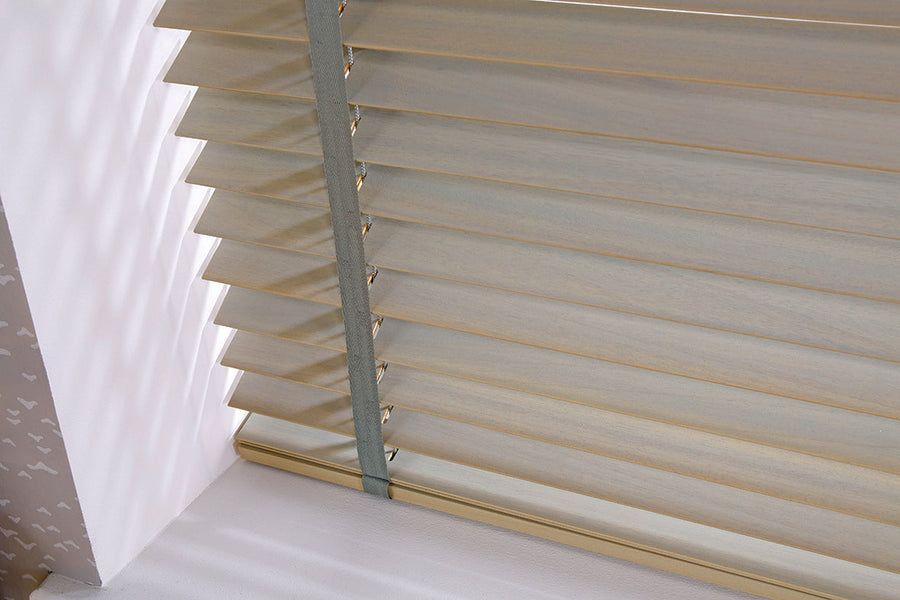
The short version
A gentle rule of thumb is to dust often, wipe lightly and keep water away. Wood is a natural material. It is happy with a dry cloth and prefers not to be soaked, and most of the care below follows from that one fact.
Finishes differ between ranges, so treat this as general guidance. If you're unsure about a particular blind, we're happy to advise before you try a new cleaning product. You can read how real wood compares with faux wood in our wood or faux wood comparison.
A routine that takes five minutes
Every week or two
Tilt the slats so they lie flat and closed, then run a soft, dry microfibre cloth or a feather duster along each slat from one end to the other. Tilt them closed the other way and repeat, so you catch the second face. Dust sits on the top of the slats and also builds up on the cord ladders, so give those a pass too.
A handheld vacuum with a soft brush attachment on a low setting also works well, particularly for a blind above a radiator, where dust gets drawn up the window.
Every month or so
Check the headrail, the tilt control and the lift cords. Look for slats that are sitting at an odd angle, cord ladders that have slipped, or a blind that no longer lifts evenly. If a mechanism feels stiff, go gently, as a forced tilt wand can strip its gears.
Twice a year
Give the blind a slightly more thorough clean, working one slat at a time. Wipe along the grain with a barely damp cloth, then follow straight away with a dry one. The cloth should feel nearly dry to the touch. If water beads on the surface or runs along the edge of a slat, it is a little too wet.
What to go gently with
- Soaking or steam cleaners. Moisture can lift the finish and, over time, can cause slats to warp or swell.
- Abrasive pads and scouring powders. They scratch the surface and leave dull patches.
- Strong household cleaners. Bleach, solvents and heavy degreasers can strip or mark a finish. If a mark needs more than water, a mild product designed for sealed wood works well, tested somewhere out of sight first.
Common questions and what to try
Greasy marks in a kitchen. Cooking vapour carries fine grease that settles on slats. A cloth with a very small amount of washing-up liquid in warm water, wrung out well, followed by a dry cloth, usually lifts it. It helps to do this soon after you notice, because old grease is harder to shift. If your blind is going near a hob or sink, our kitchen blinds page covers the alternatives.
A slat that has bowed slightly. Real wood responds to humidity, and a very small movement can happen in some conditions. Closing the blind fully and leaving it for a day sometimes lets it settle. If a slat is clearly warped, it is kindest to the blind not to bend it back. Contact us and we'll talk through the options.
A blind that hangs unevenly. Usually a cord has slipped or one side is catching. Lower the blind fully, raise it slowly and watch which side lags. A photo of the headrail and bottom rail sent to us is much quicker than describing it.
Sun, damp and where the blind lives
Strong sunlight can lighten or change the tone of wood and some finishes over the years, and it often does so unevenly if part of the blind sits in the sun and part does not. Raising and lowering the blind occasionally, and varying the height it sits at, helps it age evenly. Our guide to sun glare and fading goes further on this.
Damp is the thing to watch most closely. Real wood is generally happiest in rooms without regular steam or direct spray. In a family bathroom, faux wood is usually the easier choice, and our bathroom blinds guide explains why. If you already have a wooden blind in a humid room, good ventilation and wiping condensation off the slats make a real difference.
Cords, chains and children
Venetian-style blinds have lift cords and often a tilt wand or cord. Keep all cords and chains out of the reach of babies and young children, use the cord tidies or safety devices supplied, and keep cots, beds and climbable furniture well away from a blind. Cordless and wand-operated options can reduce the risk. BS EN 13120 is the UK standard covering the safety of internal blinds. Our child safety page sets out the questions to ask.
When to call us
Ask for help if a slat is cracked, a cord has frayed, the tilt will not turn, or the blind will not stay raised. If a cord is damaged, please pause using the blind until it is sorted. Send us a photo, tell us your postcode, and we'll say what we can do. If you're choosing a blind rather than repairing one, you can book a free measure and talk finishes with us in your own room.
