How do I make existing blinds safer?
If your blinds have a cord or a chain, the first step is to make sure the loop cannot become a hazard for a small child. That usually means fitting a safety device, fixing the control out of reach, and checking that nothing a child could climb on sits beneath the window. If the blind is old, damaged or missing its parts, replacing it can be the more sensible route. Our child safety page sets out the wider picture.
Why this matters
Looped cords and chains can be a strangulation hazard for young children. A device fitted properly reduces the risk, though it still helps to stay mindful. Please follow the instructions that come with the device and the blind, and keep them somewhere you can find them.
Common devices and what they do
Cleats
A cleat is a small hook, usually screwed to the wall or window frame, around which a cord or chain is wound after use. It keeps the loop up and out of the way. A cleat works best when it is used every single time, and it needs to be fixed high enough to be out of reach, so it suits adult-only rooms better than a child's room.
Chain or cord tidies
A tidy is a small housing, often clipped or screwed to the wall, that holds the loop of cord or chain so it cannot dangle. Some tidies let the cord be pulled in and out through the housing. Fixed properly, they can reduce what hangs loose. They need careful positioning, so that the loop is kept short and tight.
Tension devices
A tension device holds the bottom of a loop under tension against the wall or frame, so the loop cannot be pulled out and held as a free circle. It is screwed to the wall or window frame, and the loop runs through it. It needs to be fixed so that the cord or chain is held taut at all times, because the right tension is what makes it work.
Breakaway or safety connectors
Some chains have a link designed to separate under load. These come built into some blinds and are best left just as the maker intended. Ask whether a blind has one and what the supplier says about it.
Safety clips and ties for cords
Separate cord pull-ups, ties and clips exist for the lift cords of venetian blinds and similar types. They manage the loose end. Again, they work best when they are used every day.
How fitting generally works
- Choose a position. It should be high, not reachable from furniture, and where the loop hangs without touching anything.
- Mark and fix. Use the screws supplied for the wall type. A device that pulls out of a wall cannot do its job, so check the fixing is firm.
- Thread the loop. Follow the instructions for how the cord or chain passes through, and whether it needs to be shortened.
- Test. Operate the blind and check the loop stays taut and the device holds. Look at the loop from a child's height.
- Review regularly. Screws loosen, and children grow.
Fitting differs between wall types, window frames and blind designs, and some blinds may not suit a given device. If you're not sure, ask whoever supplied the blind.
When replacing is a better idea
- The blind is worn, frayed or no longer operates smoothly, so cords are being handled more.
- No suitable place to fix a device exists, for example a frame that cannot take screws.
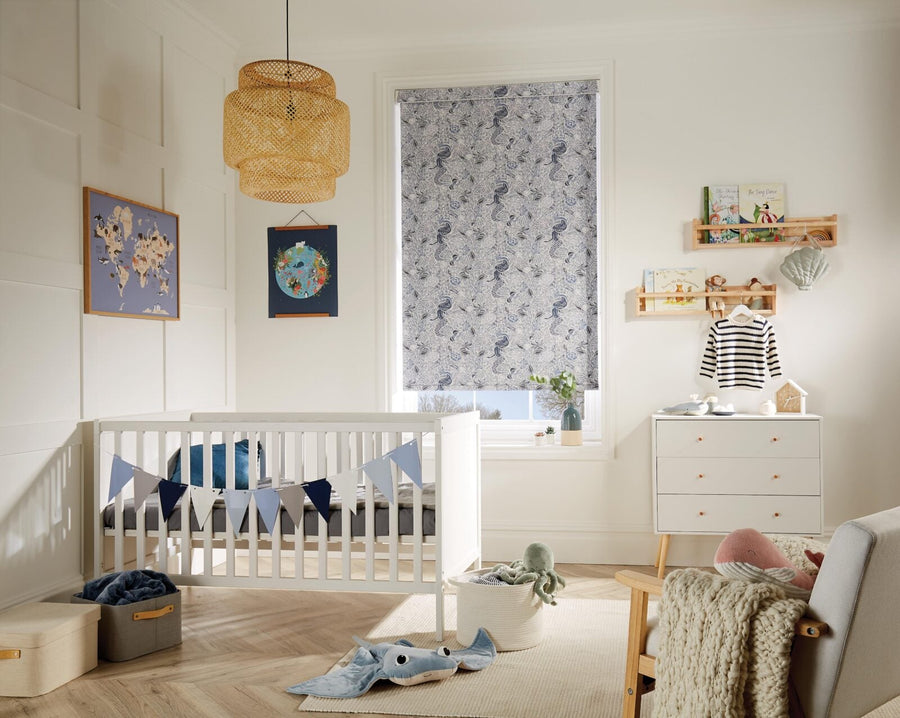
- The blind is in a nursery or a room used often by young children.
- Parts are missing, or the safety device that originally came with it has been lost.
In those cases a new blind that has no cord at all, or a motorised version, can remove the hazard rather than manage it. A simple roller blind can often be made cordless, though not every size suits that. Ask what suits your window.
Habits that help
- Keep loops tucked up and out of reach.
- Keep beds, cots and sofas away from window blinds.
- Check every window in the house, including landings and spare rooms.
- Tell visitors and carers, so everyone follows the same habits.
Which blinds are most likely to need attention
Any blind with a looped chain, such as many rollers and verticals, or with lift cords, such as venetians and Romans, should be looked at. Cordless and motorised blinds do not have these hanging loops, although it is still worth reading their instructions. A blind installed years ago may not have had the safety fittings that are expected now, so it is worth checking even if it has never caused a problem.
Get a second pair of eyes
If you would like us to look at what you have, or talk through cordless options, we're happy to. Book a free measure and mention the blinds you are concerned about.