
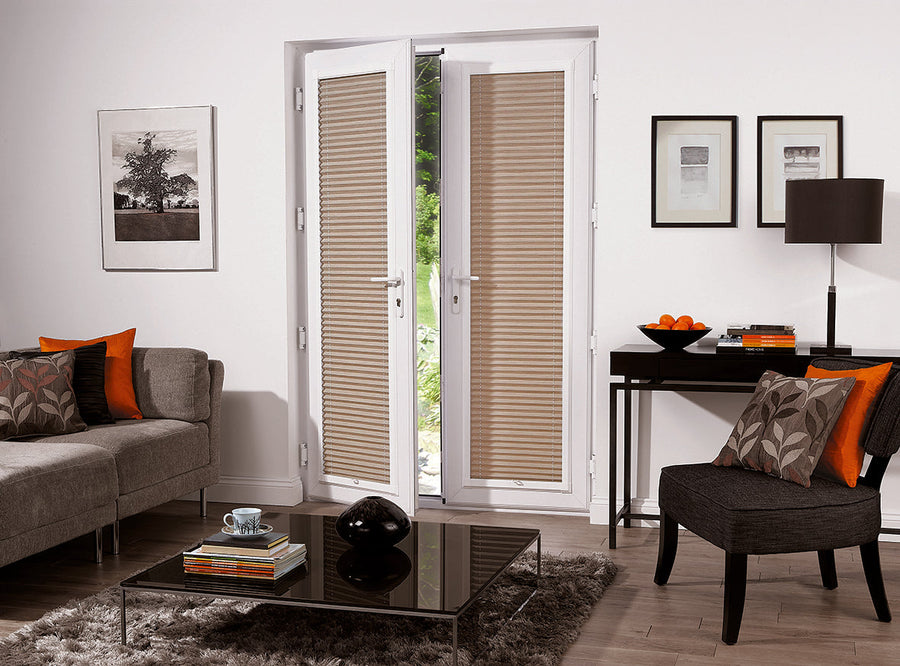
Tilt and turn windows are common in newer homes and in many replacement window installs. One handle gives you two actions: turn it a quarter and the window tilts in at the top for ventilation, turn it further and the whole sash swings inward like a door. That is clever and practical, and it just means blinds need a little extra thought.
What to keep in mind
Because the window opens into the room, a blind has to share that space. Three things are worth bearing in mind:
- The sash swings into a blind fitted outside the frame and knocks it.
- The blind, hanging in front of the glass, stops the window from tilting or opening fully.
- A loose bottom bar or cord swings into the gap when the window tilts, and the blind rattles or catches.
None of these is a reason to go without a blind. A good choice of blind and fitting takes care of them.
Fitting inside the frame
A blind fitted within the opening sits close to the glass, inside the reveal. Often this is the neatest answer, because the blind is out of the swing path. But the sash opens inward, so the blind has to sit tight enough to the glass that the open sash is not blocked.
The clearest example is a Perfect Fit blind, which is fixed to the window frame itself and moves with the sash. When the window tilts or opens, the blind goes with it. It is worth checking the compatibility first, because not every frame is suitable. Read our Perfect Fit compatibility guide and the Perfect Fit blinds page. Fitting inside the frame this way also leaves the frame undrilled.
Fitting outside the frame
An outside fit can work if there is enough space between the blind and the window for the sash to swing and the handle to turn. That space depends on the window and the blind, so there is no single figure. A deeper bracket can help, and so can a blind positioned high and wide enough to clear the opening. The trade-off is that the blind sits further into the room and may swing in a draught from a tilted window.
If the window is often left tilted for fresh air, ask about a blind with a weighted or restrained bottom bar, or a blind that can be fixed at the sides. Not every range can do this, so we'll tell you what is possible.
Which blinds suit tilt and turn windows
- Perfect Fit blinds are often a lovely answer where the frame allows, because they travel with the sash.
- Roller blinds are slim and give clearance, particularly in a recess fit. Check where the handle sits against the roll.
- Pleated blinds are slim in profile and can be fitted close to the glass, which helps a swinging sash, depending on the range.
- Venetian and wooden blinds hang freely and can swing in a draught, so they need a little care and are often better as a face fit above the swing.
- Roman blinds stack thickly at the top and need more depth than the others, so check the clearance.
Vertical blinds are less often chosen for this kind of window, though they can suit a large tilt and turn door. Ask us and we'll talk it through.
Things to look at on your own window
Handle position and size. The handle sits on one side, usually the inside edge. Note which side and how far it protrudes.
Which way the window swings. It hinges at the side when it turns, and at the bottom when it tilts. The blind needs to clear both.
Gap to the cill and any radiator. The open sash needs a path. A deep cill or a radiator beneath can reduce it.
Frame material and edges. Not all frames take a blind fixed in the same way. Metal and timber frames, for example, may need a different approach from uPVC.
Child safety. The bottom of a swinging sash is within reach of small children, so cords and chains need to be kept short and tidy. See our child safety page.
How to measure
Measure the window as you would for any recess, but also record the handle position and the clearance, and take photographs with the sash open. For the method, read how to measure for blinds and the recess or exact fit guide. It can also help to try the window itself before we visit: tilt it, turn it, and note anything that sticks.
Do they need a different type of blind?
Not necessarily. Plenty of tilt and turn windows have ordinary roller blinds fitted without fuss. The point is to choose the fit with your window in mind. Where the window is a particular shape, our guide to awkward windows may help.
Let us look at it
Tilt and turn windows differ between makers, and the details matter more than the label. Describe what you have, or better still, book a free measure. We'll open the window, check the clearances and suggest what suits.
