What changes when the evenings darken?
When the clocks go back, the light fades earlier, lamps go on sooner and the windows turn into black mirrors. People walking past can see in more easily than you can see out. So it is a good moment to look again at how your windows are dressed, thinking about privacy, light, warmth and comfort rather than just looks.
Privacy comes first
A blind that gave plenty of privacy at noon may offer very little once the lights are on inside. Thin white fabrics, sheers and voiles show shadows and silhouettes after dark. Think about each room.
- Front rooms and ground floors. These need the most thought, because the street is close.
- Rooms you sit in after dark. A living room or kitchen with large windows may need something heavier in the evening.
- Bathrooms and landings. Check frosted glass works at night with the light on.
Our guide on privacy without darkness covers fabrics that filter daylight but can still protect you in the evening.
Two-in-one: a blind plus curtains
Many people find that a daytime layer and an evening layer is the most flexible. A blind handles daylight and glare, and curtains close across the top at night. This also helps with warmth, since a thicker layer holds more of the heat in. If you're weighing it up, our curtain or Roman blind article compares them.
Softer, warmer rooms
As the evenings darken, the feel of a room matters more. Hard, bare windows can feel cold. Fabric helps.
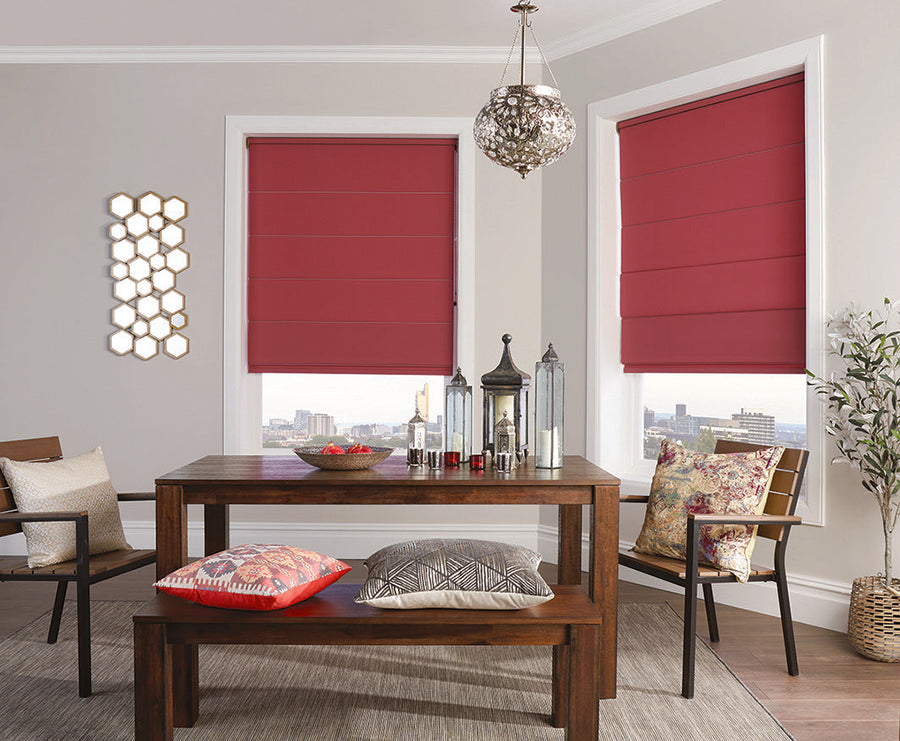
- Roman blinds. When lowered, they bring texture and a layered look, and they can be lined for extra body. See Roman blinds.
- Curtains. Heavier fabrics, lined or interlined, create a cosy feel. See curtains.
- Colour and pattern. Warm, deeper tones tend to feel snug in winter, though it is worth checking them in daylight too. Our colour guide may help.
Lighting and glare
Blinds and lamps work together. A few simple ideas:
- Warm lamplight reflects off pale fabrics, so a light-coloured blind can make the room feel brighter.
- Low winter sun can still glare in the afternoon on a screen or television. A blind that angles or lowers partially helps.
- Consider whether you want a blind you can lower from the top, letting in light at the bottom or top depending on privacy.
Staying warm
Closing the blinds earlier in the evening, before the glass chills the room, helps comfort. A fabric with some thickness, a cellular structure or a lining works better than a thin one. We cover this in our thermal blinds guide, including what you can realistically expect.
A short autumn checklist
- Stand outside in the dark with the lights on and see what can be seen.
- Check that blinds and curtains reach the sill, or close as far as the window allows, with few gaps.
- Wipe down blinds and curtains. Dust shows in autumn sunlight.
- Check cords are tidy and secured, particularly if children are home more often. See child safety.
- Think about timers on motorised blinds so they close at dusk without you having to remember.
Think about the whole evening
Dark evenings are also when the household is home together, so windows do more work. A kitchen blind may need to cope with cooking steam and bright task lighting. A home office window may need glare control until the afternoon light has gone. A child's room may need a blind that darkens enough for bedtime while it is still light outside. Walk through the day room by room and note which windows have a different job in October than they did in July. It is often only one or two.
No need to replace everything
You may not need new blinds. Sometimes a lined curtain added to an existing blind is enough, or just moving the blind position. Think about what bothered you last winter: privacy, cold, glare or a window that felt bare. Start with the worst window and see how it feels.
Get a second opinion
If something is not working, it helps to see it. Book a free measure and we can talk through your windows while it is still early in the season, so you are ready for the long evenings.