Which control should you choose?
It depends mainly on how high the window is and how often you plan to use the blind. If you can reach it comfortably and you are happy to pull a handle, manual control is the simplest. If it sits high above a bed, stairs or worktop, an electric or solar-powered version can be much more practical. There is no right answer for everyone, only a better fit for your window, your routine and your home.
Manual control
A manual blind usually has a handle on the bottom bar that you pull down and up, often with a catch or side rails to hold the fabric in place. There is nothing to charge and nothing to wire, which makes it the least complicated option and the easiest to keep working. The drawback is reach. If you have to stand on a chair or a bed to touch the handle, you'll probably leave the blind where it is. Manual blinds also suit people who like to adjust by hand and feel the position.
Electric (mains or low voltage)
An electric blind has a motor controlled by a wall switch or a remote. The motor is powered through a cable to the mains, either directly or via a transformer. This suits a new build or a loft conversion where cables can be hidden before decorating, and it is reliable once installed because it does not depend on charging. It is less convenient in a finished room because wiring may mean opening plaster. A qualified electrician should deal with the connection. See motorised blinds.
Solar-powered
A solar blind has a small panel that charges an internal battery from daylight, so there is no cable to run. This is attractive on an existing roof window, because you avoid wiring and can usually operate the blind with a remote. The panel needs light to charge, so a heavily shaded window or a run of dull winter weeks can reduce how much power is available. How it behaves depends on the product, so ask for the maker's guidance and have a look at the product information.
Comparing them side by side
- Reach. Manual needs you to reach the window. Electric and solar do not.
- Power. Manual needs none, electric needs a cable, solar needs daylight.
- Installation. Manual is straightforward, solar is usually simpler than mains, and mains needs wiring.
- Cost. Powered options generally cost more than manual, and wiring adds to it. Figures depend on the window and range, so they are best talked through with us.
- Maintenance. Manual has the least to go wrong. Powered systems may need a battery or a motor looked at eventually.
Which suits which window
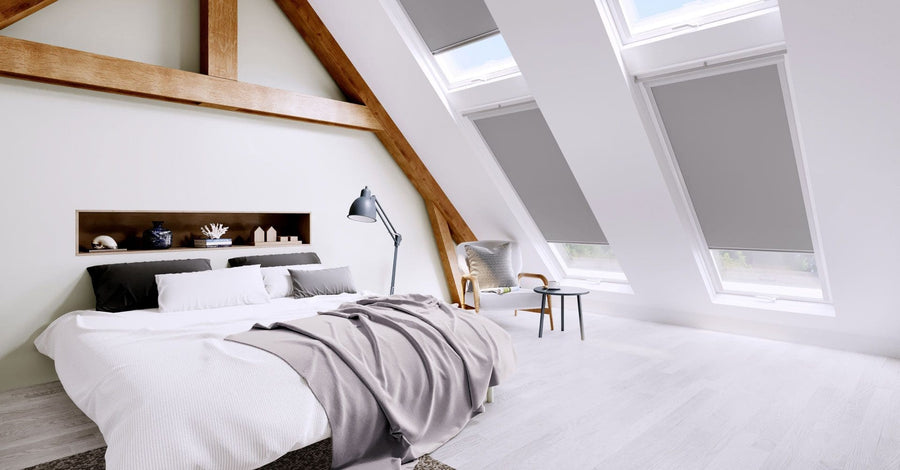
A roof window above a stairwell or a high bedroom is a candidate for electric or solar. A low roof window in a spare room that you use now and then may be fine with a handle. If several windows sit side by side, a single remote that controls them all can be neat and is easier to use than reaching up to each one. If you're unsure which type of window you have, see how to identify your roof window.
Compatibility
Blinds, motors and window models need to match. A blind made for one frame or one control system may not work on another. Look at our page on Velux roof window blinds for the general picture, and tell us the model details so we can check what suits. A remote from one brand will not always operate another, so it is worth checking first.
Safety
Manual blinds on high windows often avoid long loose cords, but it is worth checking anyway. Motorised options remove cords entirely. Our child safety guidance explains what to watch for.
A practical way to decide
- Stand where you would normally use the blind. Can you reach the handle?
- Decide whether you want to adjust it daily or seasonally.
- Check whether a cable could be run, and whether the window gets reasonable daylight.
- Think about the remote: one for the room, or one per window?
If you're on the fence, a conversation at the window usually makes the answer obvious.
Book a free measure
If you would like a second pair of eyes on the window, book a free measure and we'll talk it through with you at home, with the actual glass in front of us. Or call us on 01642 424250.